Heavy Pepper Periodic #3
Welcome to the third issue of Heavy Pepper Periodic! On the docket this month:
- Pathika Production Update
- On the Blogs and Bluesky
- Pathika Preview: Rival Guilds
- Media Recommendation: Suikoden I, II and III
Pathika Production Update
The Pathika (my adventurer city book) preview book is in layout!
I thought I was done in 2022 when I completed Pathika's first draft. Then I thought I was done in 2023 when I decided, perhaps against my better judgment, that I should increase the number of NPC descriptions in the back of the book from 50 to 108 and also assign them to each of the 108 stars of destiny from the Water Margin. As you can tell, this book has encountered some scope creep up to this point, all of which was entirely my fault.
But there was one bit of scope left to be creeped. You see, I planned to commission an art piece which would be a cross section of an adventurer's guild, with a sparse key annotated on the image itself. It would be a location the players could use as their home base or a sample adventure into a rival guild HQ. However, it would be costly to commission such a big piece ahead of the crowdfunding campaign and it felt wrong to release a preview of the book without a keyed, explorable location. So I decided I would write this location out as an adventure instead.
That's right, two feet from the finish line I decided to write a whole ass module and throw it in the book, including in the preview. So now the preview has an additional 40 pages of content. As crazy as it sounds, it felt like the right decision because I felt that the preview needed a fully fleshed out bit of content that showed off the tone and internal logic of Pathika in the smallest details.
The module is focused on internal guild politics but is also written to provide an interesting sandbox to explore, connive within, and slowly break apart if the players wish to, and I tried my best to make the layout, the unfolding scenarios, and the various game objects show off what is unique about the city. My hope is that by including this in the preview, you will definitely be able to hit the ground running with the kind of campaign the full book imagines. It also means this preview is going to be pretty beefy, and the full book is going to be probably the most content-packed city kit currently available.
Anyway, you have my sincere apologies for delaying this book another ~4 months to write this latest addition, but it's finally going to layout! It's happening!
P.S. In other book news, Nielsenauts got a Japanese translation! The translator, Wadatea, made some intriguing additions to the interior design which I think will help communicate the vibe. Get it from here if you're looking for a weird collector's item.
On the Blogs and Elsewhere
As you've probably noticed, my return to public online activity has been split between BlueSky, the blog and this newsletter, and it's actually been a little tough to figure out what should go where. What I've landed on for now is this: this newsletter will focus on the exclusive previews and production updates plus some shortform thoughts on media or TTRPG recommendations. Pathika Blog will continue to be where I do the devlogs (which walk through how I wrote Pathika and sometimes double as GM prep advice) and longform essays on games. BlueSky is more or less for everything else, but you've probably noticed that I like to do threads on game design there, much of which should probably also be cleaned up and posted to Pathika Blog at some point. Unfortunately, as BlueSky is how I get people to look at this newsletter or the blog in the first place, a lot of content is going to end up on there in some rough form. However, I will continue to keep you apprised of my activity in these newsletters so you can find the other content.
So with that in mind, here's some additional reading you might be interested in across these two other platforms:
Pathika Preview: Rival Guild Creation
I've talked before about why having a steady supply of rival adventurers helps solve a lot of small scenario creation and dungeon crawling design problems at once. It is, as you'll see in that blog post, one of the primary reasons I tend to use a city with adventuring guilds as the hub for my D&D-adjacent campaigns.
One of the major focuses of the Pathika city book will be on helping you integrate these rival adventurers and guilds into your campaign; everything from creation to mapping relationships to tracking their activity. There are tables, GM advice, mechanics and sample content for all of these things, but for this preview we'll focus on creation of rival guilds.
Pathika has generators for three key aspects of a guild: their trademark, their assets and their agenda. Why these three? Because as far as interactions with a guild go, I think players need to know how to clock them on the street quickly (oh this must be the Busty Boys' turf), what could be gained or lost by conflict or negotiation with them (we don't want trouble with the Rough Riders, they have a monopoly on horses in Pathika), and what actions they might take in the background. Below are some previews of the d20 tables for each element.
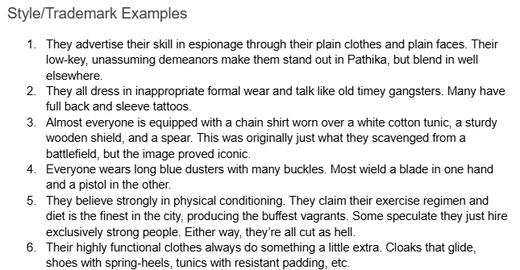
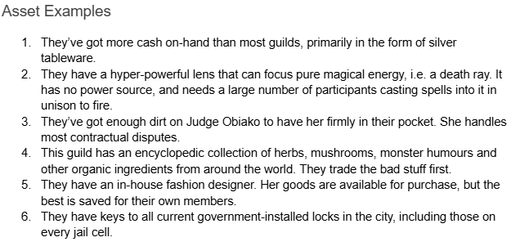
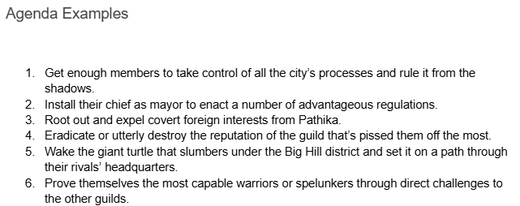
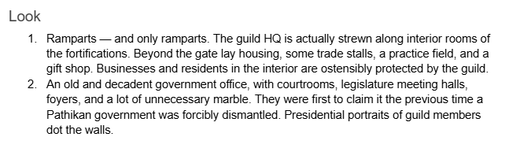
Once you've generated a guild, you'll probably want to make their HQ a unique and memorable place for the players to visit at some point. There are d20 generators for that as well (and as mentioned above, a large HQ has been fully keyed as an adventure site and will be included in the preview book).
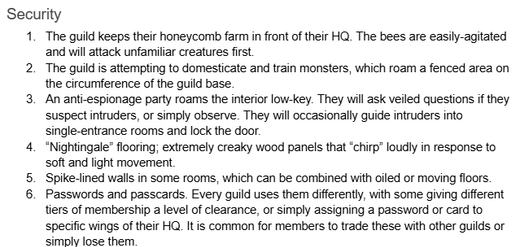
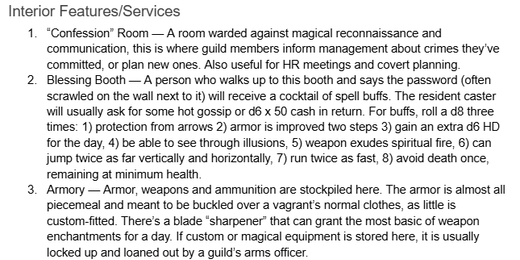
Once you've gotten the main guilds of interest generated (the book provides some advice on what to do with the others), you'll want to figure out their relationship with your players' own guild. The way the book handles this is via a worksheet that you can write guild names into, which looks kind of like those old anime relationship diagrams you might have seen back in the day. There's one for guild relationships and individual character relationships too. Here's a small peek at what the nodes on the guild one look like:
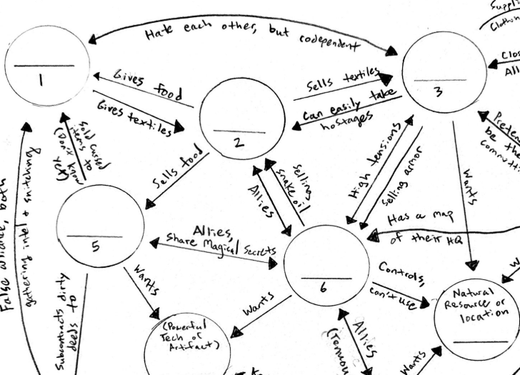
I'll probably share the full hand drawn versions of both of these worksheets in a later preview.
One of the philosophies I followed in writing this book was that there should be three versions of most of the content I discuss: 1) instructions on the whys and how of creating content, 2) generators to help inspire you in making your own content, and 3) fully authored examples of content.
Due to this book already being massive, I couldn't follow this principle with everything included. For example, there's no tutorial on writing your own crisis list, just a fully authored version of it to use as an example. Instead, I chose to do this with things that you will want to be especially personalized to your campaign, such as geography, guilds and vagrants (adventurers). With that in mind, the "Emergency Material" section at the back of the book contains 20 write ups of guilds you could drop into your campaign. Here are a few:
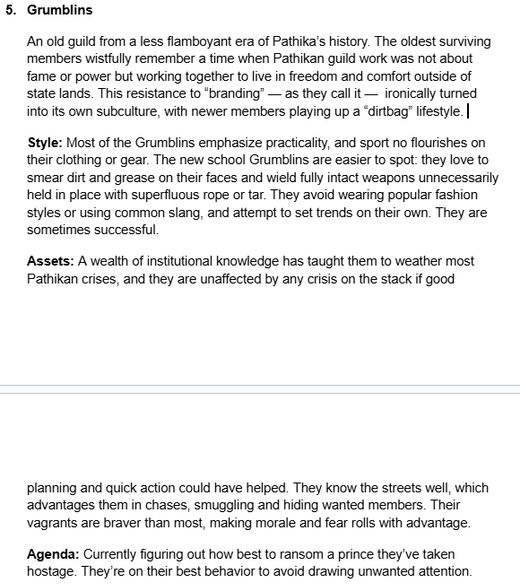
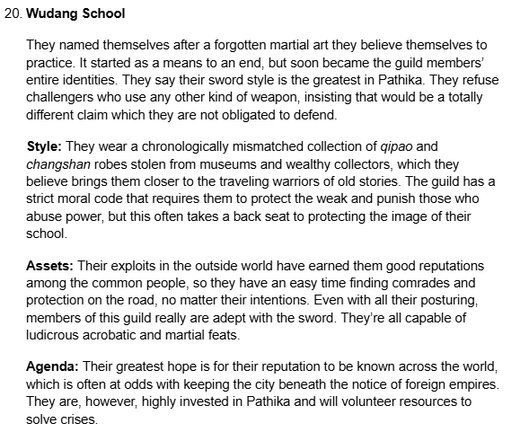
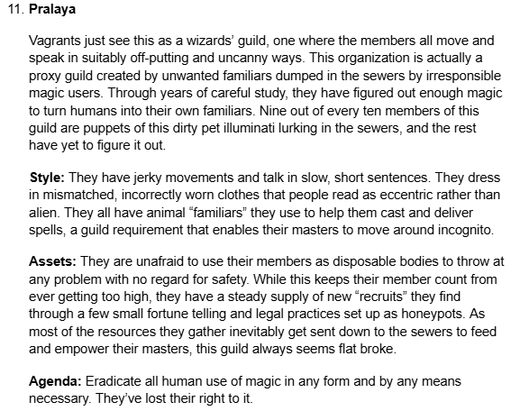
As always, forgive the Google docs screenshots. As the book goes through layout I will fancier versions of these to share.
Media Recommendation: Suikoden I, II and III
Given that I'm writing a TTRPG setting book inspired by the Water Margin, it seems mandatory that at some point I shout out the Playstation RPG series that is also based on the Water Margin, and which has inspired my fantasy writing so much. You can feel this series in the bones of Pathika, though I didn't go out of my way to make this specifically a "Suikoden" book. It was, however, content made to suit a Suikoden campaign I was running.
For those who don't know, Gensou Suikoden (lit. Fantasy Water Margin Story; Suikoden is the Japanese pronunciation of the Chinese title of Water Margin) is the first title in a Japanese RPG series which began on the PS1 in 1995. It's a party-based RPG where you, as the turncoat son of an imperial general, must assemble 108 allies and an army to rebel against the empire. And while the plot changes between titles, there's always a rebellion of some kind, always 108 allies to recruit, and always some kind of political intrigue to navigate. The games feature a pretty unique blend of Chinese flavor with more conventional Western European fantasy. You can get a sense of the aesthetics in this thread, so I won't rehash all that here.
What makes the Suikoden series so interesting to me is that they fully embrace the idea of being video game story books. They're relatively linear (though you'll always be re-exploring the map for rare items and to recruit more people), they focus strongly on the characters and plot over complex game systems, and many of the features seem to be focused on making them easy to play but with a strong emotional impact. They ask little of you but provide a lot in return.
An easy example of this is the battle system. Suikoden I and II's battle systems are really simple on paper: you've got 6 party members who can each attack, use a spell/ability (most of which use vancian casting or are limited to once per battle), team-up attack or item, or defend.
What makes the combat stand out is that all of the actions are queued up before the round starts, Dragon Quest style, and then they're resolved simultaneously when possible. You'll see multiple enemies and allies jumping into each other's lines at the same time, as the game has an interesting take on initiative where any characters adjacent to each other in the initiative order whose actions don't interfere with anyone before or after them all do their stuff at the same time. This seems like a minor change to classic turn based combat, but it makes every round of battle feel more chaotic and dynamic. And when you add in things that will play out slightly differently based on chance, like dodges and counter-attacks, high skill characters in Suikoden II being able to attack multiple enemies, etc., it can be entertaining to see how a round of combat resolves even if you're making exactly the same choices as you did the previous round. There are few console RPGs I can say this about! Suikoden III makes things a bit more complex by making movement and positioning matter, but it keeps this same spirit of "I wonder what will happen this round" that makes battles fun to watch. I find it weird that this style of action resolution has largely not returned in RPGs today.
Beyond that, the games have all kinds of interesting little conveniences for the player which keeps the momentum going. Of the 108 characters available, usually at least like 50-60 are usable in combat, and the game has a "catch up" mechanic to EXP which makes it so that if you switch new party members into your lineup they jump in levels drastically, getting them to your average party level with no grinding necessary. There are no obtuse character building mechanics to look up or understand: all your customization comes down to what runes (which give spells and special abilities) you assign to each character, which can be freely rearranged as needed. It allows for a good amount of variety in party building without having a lot of small decisions to make. Also, if you stop playing for a bit and forget what you're doing, your HQ even has a meeting room where your strategist will usually remind you of what your current mission is.
Besides the cool aesthetic, combat, and story, I think a lot of people remember Suikoden fondly because of the sheer breadth of the experience. Breaking up the standard RPG adventures are very wuxia-feeling duels styled like fighting games and the occasional large scale battle between two armies. In some cases that I won't spoil, you'll weave between all three of these scales to accomplish a particular objective.
And if you decide to take a break from your adventures altogether, you can walk around your HQ, chatting up your recruits and messing with various HQ side activities. These are ingeniously designed to make full use of the game's large cast. For example, in Suikoden II you can ask your detective to investigate one of your characters to learn more about them, or play a cooking competition side quest where your recruits judge your menu selections according to their unique tastes. Suikoden III takes it to another level by having a theater where you can cast your recruits in different roles in the play, each of whom will play the role slightly differently.
It's hard to summarize what makes these games legendary succinctly, as they just do too many things right. But the headline here is they've got unique stories and aesthetics, simple but moreish game mechanics, and generally respect your time. Of all the 90s Japanese RPG series you could go back to for TTRPG inspiration, these will give you some of the most inspiration the least tedium and time invested.
As for which versions to play, it's kind of a wash. If you emulate them, you'll have access to things like save states and fast forward, and you'll be able to load data from Suikoden I into II (highly recommended) and then load that data into III to see your names, choices, etc. referenced all the way through the trilogy. There are HD remasters of the first two out which will allow you to load data from 1 into 2, but obviously not into 3 which is not included. The HD remasters are, well, fine. They make some weird choices like slowing down walk speed in 1 so that you have to hold a button to move quickly, there no adjustment to the camera to suit the games being in widescreen now so you'll have strangely framed cutscenes, and rather than redraw some of the environment assets they just turned them into black walls. On the other hand, you can speed up battles without speeding up the music (these games have great soundtracks) and you can apparently turn off the time limit for a pretty cool optional side quest in Suikoden II. All in all, I don't think you can really go wrong with either choice, though I am partial to the original releases.
I know this has been a longer media recommendation than previous issues, but that's just how close to my heart these games are. If you find Pathika's blend of Western and Eastern fantasy appealing, I have no doubt you will also find a lot to love here.
Back Issues
Issue 1
Issue 2
Until Mailbob gets their back issue feature back up, I will continue linking to all back issues in each issue of the newsletter. For some reason the table of contents at the start is not showing correctly, and I'm not sure how to fix that.
Until Next Time
Questions? Comments? Things you want to see covered in the mailing list? Send them to me at [email protected], on Discord @nickoten or on BlueSky @nickoten. Your questions can be answered in the newsletters and your feedback will help me tailor the content of future newsletters, and is highly appreciated! See you next time.
|